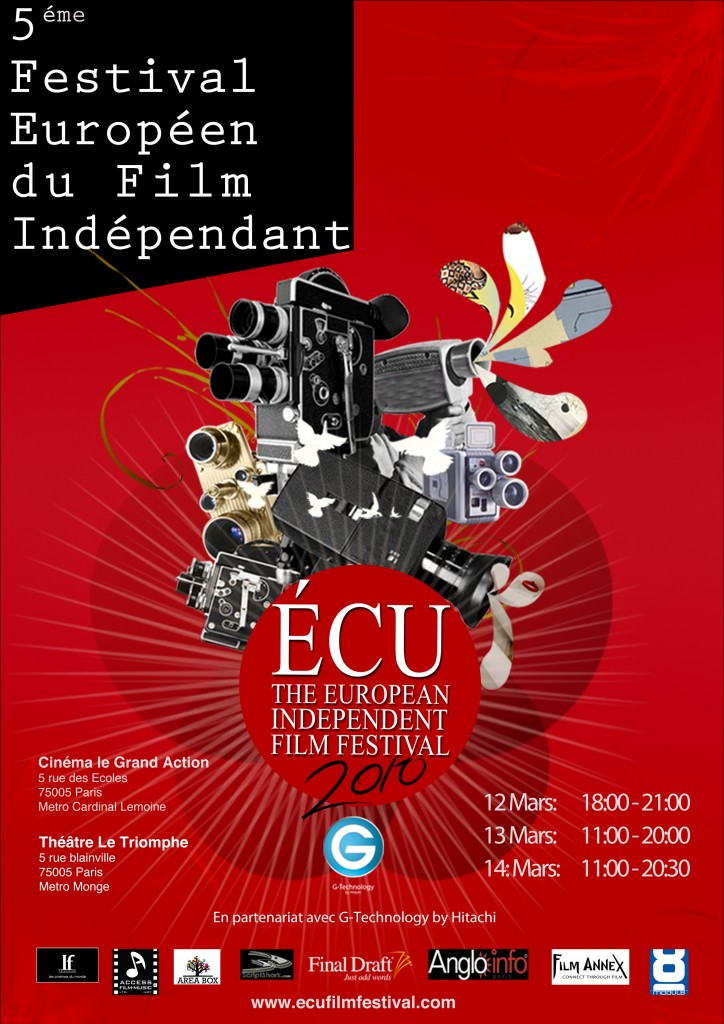
As we look back on 20 years of the European Independent Film Festival, we decided to get in touch with some of of the directors from ÉCU’s past Official Selections over the years. In this trip down memory lane, we interviewed some of our filmmakers on their past work and current projects while spotlighting the films they brought to the festival
In this edition of the alumni series, we heard from two filmmakers who participated at ÉCU in 2010. We talked about how visual storytelling has come to animate their professional and personal trajectories while getting a behind-the-scenes look at their festival entries from the past. Our guests today are Daniel Clements (Patient) and Santiago Maza Stern (Recto Recto Gancha).
Daniel Clements
“[Film] kind of chose me, it was always a compulsion…I just have to make things.”
Presently at the helm of Chakra Film Studios, Daniel Clements is a Toronto-based writer, director, and photographer. Having navigated across genres through his work on music videos, short films and most recently, a feature-film project (in development), it was in 2010 when Clements competed in the Best (non-European) Dramatic Short category at ÉCU with his widely-celebrated short film Patient.
As a child, Clements was particularly drawn to the imaginative potential of films as a means of “[showing] other people [his] dreams”. He did not have Super 8 film but used a video camera and later a VHS camera, before purchasing a mini DV camera (bought after working at McDonald’s for a year and a half) to make films in high school. Being “the medium that most closely represents what goes on in [our] heads”, visual storytelling, for Clements, was the perfect means of expressing his innermost thoughts, the images of his “mind’s eye”.
While he made his short film a decade after the Columbine massacre, Clements notes mass shootings were not as common in the US as they have been in the years since. He was curious about investigating the mind of the type of person who would engage in such wide-scale violence. Patient offers a highly original point of entry into this exploration, initially presenting itself as a “date movie” between two people before revealing the sinister nature of their conversation.
The ambiguity at the heart of the film is a powerful tool. “Let the audience finish the story”, Clements urges. Such an approach allows the filmmaker to create a genuine dialogue with their audience, transforming them into an active maker of meaning rather than a passive observer.
In the face of worrying trends towards homogeneity through streaming platforms, what he calls the rise of “AI-generated genre films”, Clements emphasises the value of film festivals like ÉCU, some of the only remaining spaces for a truly communal movie-watching experience.
Any advice for future filmmakers? “Learn how to prompt-engineer AI”, Clements jokes. More seriously, the key is to “just tell a great story”, through whatever means necessary.
Clements is currently working on a new feature film, Safe Words. To learn more about his work, check out his website.
Santiago Maza Stern
“My imagination was richer than the way I could draw.”
Navigating borders and genres, writer and director Santiago Maza Stern is presently at the helm of the documentary department of the Mexico-based production company at La Corriente del Golfo. In 2010, his widely-celebrated short Recto Recto Gancho (“Jab Jab Uppercut”) had its world premiere in the Student Film category at ÉCU.
While drawing was Stern’s first passion as a child, he soon felt limited by the medium. He turned to writing, which seemed to be a more effective means of expression throughout his teens. At the same time, the visual component was always part of his creative work, with imagery being central to his style of writing. This eventually led to his foray into film-making (“it immediately felt right”) and Stern worked in multiple creative roles before his current position as director of the documentary department at La Corriente.
The line between fiction and documentary was very distinct for the filmmaker but today he finds the borders between these creative media have become increasingly blurred. In a more visually-oriented world where ordinary people–not just filmmakers–document their lives, many of us have become habituated to performing in front of cameras daily.
Recto Recto Gancho was Stern’s very first short film, developed in conjunction with close friend, Branko Gomez Palacio. He recounts, “[Branko and I] were students and we wanted to touch on acceptance and denial.” Stern set his film in a boxing arena, introducing an ensemble of characters battling these very themes. “It’s healthier to embrace your own acceptance of things”, he notes, but at the same time, there is a “very human [tendency] to deny” difficult situations.
Having worked across different forms of storytelling, I asked Stern about whether he favours any specific medium. He asserted that while adaptations can be compelling, there is often a distinct power in the original medium. Stern, for example, reserves many of his deepest emotions for music and literature over films. At the same time, he values cinema as a “mosaic”, where one can play with different forms within the medium itself. Two films that have inspired Stern more recently are Alice Rohrwacher’s 2023 La Chimera and Alejandro González Iñárritu’s 2017 Birdman.
Stern has just finished the documentary film State of Silence, chronicling violence against journalists in Mexico, which had its world premiere at the Tribeca Film Festival. To discover more of Stern’s work, visit his website.
 English
Leave a Reply