Kostas Simitis died on January 5, 2025. If you are not Greek or a fan of European Social democracy, this information probably has not reached you and is also irrelevant to you. Nevertheless, it provoked an interesting conversation about national mourning periods since the Greek government announced four days of national mourning, causing a reaction in part of the Greek public sphere. Rusu (2020, p.119), in his comparative study of national days of mourning, argues that these are “political rites of solidarity and reconciliation”. His analysis shows that the most common reason a government announces national mourning is accidents, which are often collective tragedies resulting in mass casualties, where human factors contribute to the fatal outcome.
The fact that we are discussing incidents that involve human factors makes the notions of culpability, responsibility, and accountability integral to the conversation. Accountability is a relationship where individuals must explain and justify their actions to others and accept the consequences for them, that is, to assume responsibility for the actions taken (Agyenim-Boateng and Oduro-Boateng, 2019). Accountability is not confined to economic elements; it also includes moral aspects and has “legal, ethical, and political dimensions” (Mendez 1997, p.256).
The aftermath of an accident gives rise to a demand for accountability and justice both by the victims and by society. It is easy to understand that at the forefront of the demand are the victims and their families. It is not only their right but also a desire for the revelation of the truth. They look for answers to pressing questions such as ‘Why did this happen’ and ‘Who is responsible’. Next to the people who are primarily affected by the accident, we find society as a whole. Society stands by them in solidarity, a community that is unified under these circumstances to support the victims through various means. Moreover, sometimes society identifies with the victims, as they can relate to the situation—the accident could have happened to anyone. Thus, there is a univocal demand for justice. Lastly, and equally important, the attribution of justice shows citizens that the judiciary functions adequately and takes the lives of everyday people seriously.
Two accidents that left many dead and a powerful scar on the societal ‘skin’ behind are the fire at the Grenfell Tower (2017) in West London and the train accident in Tempi (2023) in Greece. In the Greek case, the government announced a national mourning period to greave the 57 people who lost their lives after the collision of a passenger train with a commercial one. On the contrary, the British protocol did not allow a similar decision for the 72 people who were killed that day. Nevertheless, both cases led to official investigations and to movements that supported the families and their battle for justice.
Cinema had also a saying in the process. In the British case, there are several movies, mainly documentaries, created to talk about the event, and in Greece, a two-part documentary was shot a year after the incident. In this article, we will discuss the documentaries Grenfell: The Untold Story (2021) by Constantine Grans and Μαμά Έρχομαι (Mom I’m Coming) (2023) by Giorgos Petropoulos and with the journalist Anthi Voulgari, how they depicted the situation and what is the role that a documentary can have in similar cases.
Grenfell: The Untold Story
Grenfell: The Untold Story is a powerful documentary about the 2017 Grenfell Tower fire. Using unseen footage by artist Constantine Gras, it shows the lives of residents before the tragedy and their battle with the local council about the dangerous refurbishment work. This ultimately resulted in the use of flammable cladding, which played a significant role in the devastating fire. The film contrasts their concerns with the indifference of those in charge, highlighting the systemic failures that led to the disaster.
It is a moving tribute to the victims, a call for accountability and justice, and a highlight of the community’s strength. The movie begins with the victims showing everyday items that survived the fire working as memorabilia of their lives before the fire. As they mentioned, this life seemed promising when they got a flat in this social housing building. Apart from the footage from the meetings with local politicians and the company’s leadership that undertook the renovation, the documentary depicts the consequences on the people’s lives. As it can be easily understood the sentimental footprint was severe. As a resident mentions in the film it “was not only losing your home, is people” resulting in losing “a bit of ourselves” (Grans, 2017, 54:50).
The aftermath of the fire resulted in an official inquiry into the incident. It is interesting to notice that justice and change are the two main demands of the residents and the broader movement. This becomes evident from the footage of the inquiry when a resident testifies saying that “there has to be change, we have to learn from this” to complete later on that what she expects from the inquiry is “is truth to be found” (Grans, 2017, 57:28). This testimony highlights these two demands. Justice for the victims, through accountability and the revelation of the truth, but also accountability from the part of the institutions to ensure the prevention of such incidents in the future.

Μαμά Έρχομαι (Mom I’m Coming)
This documentary is divided into two parts, but the main elements are common to the British one. The first part includes the narratives of the victims, their families, and the rescuers about the day of the accident. Moreover, the last half focuses on the sentimental aspect of the incident and its emotional echo in the victims’ lives. The second part focuses on the trial process, the infrastructure gaps, and the government’s institutional reaction.
The documentary reveals that the victims traveled for ordinary reasons with that train (e.g. going back home from vacations or work journeys) and on some occasions, the randomness of choosing this specific itinerary cost their lives. This highlights the fact that they were ordinary people in whose place anyone could have been. This is stressed out even more by the title of the documentary; ‘Mum I’m Coming’ refers to the text that most of us send to our parents before or after a journey. Furthermore, the sentiments that most of the participants share are sadness, anger, and guilt. When the focal point is moved to the trial process and the unanswered questions the central theme becomes the accountability and the attribution of justice which is demanded by all of them. It is worth mentioning that the mother of one of the victims says that the accident was “a crime against ordinary citizens, against society” to conclude that the delivery of justice “would be a vindication for them and a purification of the judicial” (Petropoulos, 2023, 41:55). This mother pinpoints that accountability in these cases is a demand not only of the victims but of the society as a whole.
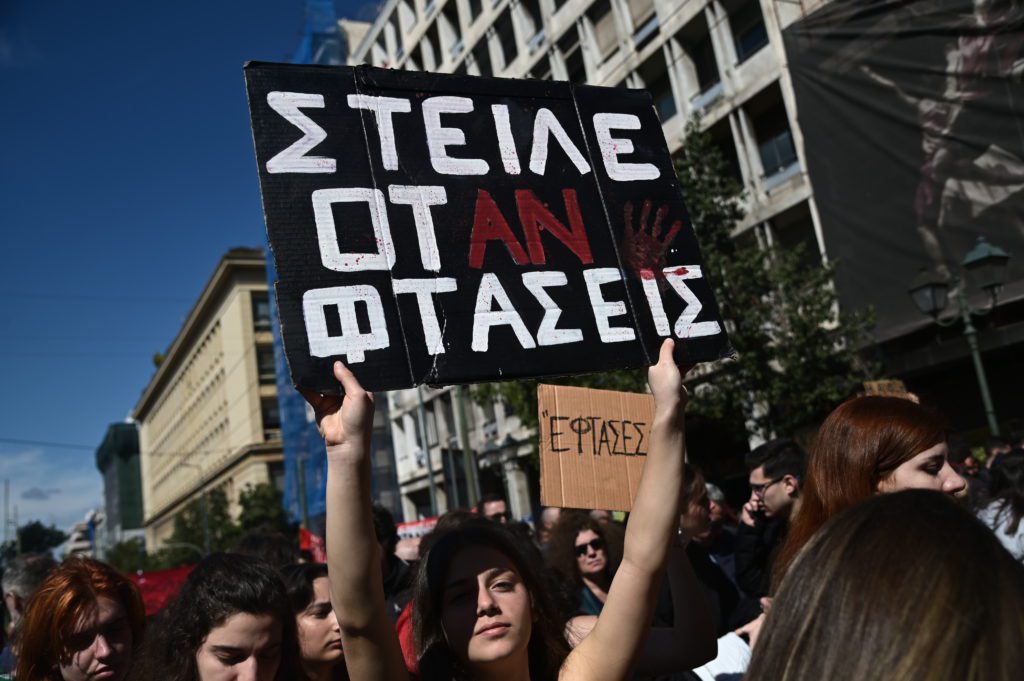
The point of this article is not to assess the aesthetics, methods, or techniques of these films, but to highlight the role that documentaries can play in such situations. The two movies may have different approaches but they reveal similar patterns and narratives. In both cases the central point is the demand for justice and as an extension for accountability that is articulated by the victims of an accident but also by the whole society. We see that the victims are willing to step up and talk about their feelings and experiences if space is given to them. This is a necessary process in the path of justice attribution and is often neglected (Agyenim-Boateng and Oduro-Boateng, 2019). These documentaries fill this gap and show the way for future similar endeavors. They demonstrate that the victims want to be heard and are bearers of important and necessary messages for change that concern the collective and its institutions.
Bibliography
- Agyenim-Boateng, C., & Oduro-Boateng, K. (2019). Accounting for disasters: Evidence of under-representation of victims in the accountability process. Journal of Accounting in Emerging Economies, 9(3), 422–448. https://doi.org/10.1108/JAEE-04-2017-0048
- Gras, C. (Director). (2017). Grenfell: The Untold Story [Film].
- Mendez, J. E. (n.d.). Accountability for Past Abuses. Human Rights Quarterly, 19.
- Petropoulos, G. (Director). (2023). Μαμά Έρχομαι (Mama Erchome) [Film].
- Rusu, M. S. (2020). States of mourning: A quantitative analysis of national mournings across European countries. Death Studies, 44(2), 117–129. https://doi.org/10.1080/07481187.2018.1526830
 English
Leave a Reply