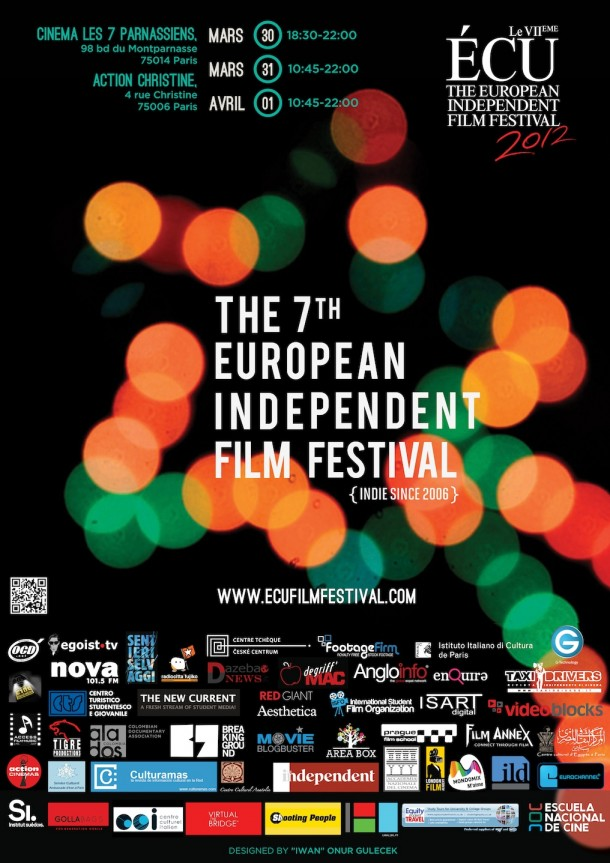
As we look back on 20 years of the European Independent Film Festival, we decided to get in touch with some of of the directors from ÉCU’s past Official Selections over the years. In this trip down memory lane, we interviewed some of our filmmakers on their past work and current projects while spotlighting the films they brought to the festival
In this edition of the alumni series, we heard from four of our entrants for the Best Student Film category in 2012. We talked about their professional and creative trajectories as well as their experiences participating in the festival. Our guests include Jonathan Reid-Edwards (Hadley TK-421), Ghena Hachicho (Rima in Beirut), Sezen Kayhan (Time of the Plums), and Andrés Moret Urdampilleta (A Little Push).
Jonathan Reid-Edwards
“The power of cinema [is] to turn the everyday into something just beautiful.”
Working across genres including the short, the music video and his most recent 2019 feature film, The Good Neighbour, Jonathan Reid-Edwards is a writer and director based in the UK. In addition, he teaches film and storytelling at LAMDA. Initially working in various roles in film sets around London, Reid-Edwards eventually decided to enrol at Drama Centre London. It was here that he developed his widely-celebrated black comedy Hadley TK-421, the culmination of his degree in directing. In 2012, Hadley TK-421 competed in the category for Best Student Film.
Set in a stylised corporate London in the 1960s, Hadley TK-421 was born, at the outset, in opposition to the prevailing trends in the genre. “I looked at what every single short film was doing at the time and tried to stay away from that”, Reid-Edwards explains, working instead to create something unexpected for his audience.
Anchoring his film in the exploration of the “complete indifference of the universe”, while keeping his audience laughing, the film allowed him to hone his directing style. Built on the one hand on creating aesthetically stimulating films and on the other hand on collaborating with actors, Reid-Edwards’ approach is one that he feels he is constantly perfecting.
Bringing Hadley TK-421 to ÉCU was an overwhelmingly positive experience, explaining, “what I loved about ÉCU [was] that during the festival and afterwards–when I’d been at Cannes and I’d bumped into members of the festival there–is that it’s probably one of the only festivals where I feel like there’s a continued sense of community”. ÉCU’s community spirit was one Reid-Edwards felt was championed the short film. As he notes, “I was in the Student Film category but actually my film was being screened also before feature films…and that meant the world to me because it meant that it got to a much bigger audience than other festivals would.”
Hadley TK-421 is a short film rich with subtext. In one scene, a character is asked what he writes, to which he sardonically responds “words, sentences”. I wondered whether the interaction pointed to Reid-Edward’s own evaluation of the image and the text and whether he favoured the impact of visual storytelling. He agreed, affirming the non-verbal as the source of power of cinema. “With a really good film…you should be able to turn the sound [and subtitles] off and still know what the film’s about”, he explains, citing Wim Wenders’ 2023 feature Perfect Days as an example of visuals creating profound meaning from elements of the quotidian.
Most recently, Reid-Edward has been developing a feature film on the experience of growing up as mixed race. To learn more about his works, click here.
Ghena Hachicho
“When you see something next to you [directly], you relate to it–you feel sad, happy, [or] empathetic.”
Ghena Hachicho is a Lebanese writer and director based in London. After completing her degree in cinema studies from Saint Joseph University in Beirut, Hachicho pivoted to film editing. Since her move to London, she has edited commercial films but also independent cinema, mostly documentaries, which remain her passion. Rima in Beirut was her graduation film, with which she competed for Best Student Film at ÉCU in 2012.
Hachicho’s cinematic journey began in high school, when an English teacher asked the class if they preferred to write an essay or make a movie for their final-year project. Hachicho chose film, and with a mini DV camera, decided to record life in school, later teaching herself to edit the movie on her computer. Her work since Rima in Beirut has involved a closely collaborative process, more recently on the 2020 documentary feature, We are from There, directed by Wissam Tanios. Based on Hachicho’s editing of the first half of the film, Tanios was able to develop the second part.
Exploring the first impressions of a new city, Hachicho’s student film Rima in Beirut is a semi-autobiographical portrait of a young student who discovers the images of the same man in the photographs she takes. “It’s not a heavy film, it’s a very light [one] about my experience when I moved from my city, Saida, to the capital, Beirut.” Mining the humour in daily interactions with characters from the city, the film is ultimately a portrait of Rima’s–and indeed Hachicho’s– “love of cinema”.
Returning to Hachicho’s anecdote of the choice offered by her English teacher between essay and film, I asked the filmmaker about where and how she regards visuals as winning over text, particularly as someone who has worked across different genres in visual media–both commercially driven and politically charged. “From my perspective, of course, I see [visual storytelling] as more powerful. People prefer to see something–especially now on social media–in the moment. You have a direct impact.”
Hachicho is currently in the process of editing her first feature film, Fading Chords, about an eccentric Lebanese musician who decides to fulfil his dream of becoming a rock star during the civil war. To learn more about Hachicho’s work, check out her website.
Sezen Kayhan
“I think [comparing text and visuals] is like comparing two different languages.”
Navigating borders and genres, Sezen Kayhan is a Turkish artist, filmmaker, and researcher based in Germany. Studying art in high school before going on to get her Bachelor’s degree in archaeology and art history and Master’s in film, Kayhan’s academic trajectory was complemented by stints in art departments in different productions worldwide. Presently, she is working at Johannes Gutenberg University in Mainz as a lecturer and post-doctoral researcher.
Kayhan’s films have received international acclaim at Tribeca, BFI London, and a range of international film festivals. In 2012, her widely-celebrated debut short film Time of the Plums competed in the Student Film category at ÉCU, and won the E-Inclusion Film Award.
Inspired by a deeply personal experience–the loss of her grandfather with whom she lived as a child–what she considers her “first encounter with death”, Time of the Plums was born out of Kayhan’s reflection on losing someone with whom one shared one’s life. The film chronicles the experiences of the 10 year-old hearing-impaired Yasemin, who lives with her mother and grandfather in a coastal town.
For its accessibility to the hearing-impaired through its representation of sign language, Kayhan’s film won the first E-Inclusion award at ÉCU, a rare honour, as she notes, “many festivals [didn’t] have this approach to accessibility” at the time.
Kayhan has worked across the gambit of visual media (film, television, art) and her incorporation of sign language into her feature further expands the nuances within visual media and communication. When I asked Kayhan whether she valued visual storytelling over written forms, she dissented, asserting text and visuals are inherently different languages. She added, “In some cases, I believe, text can be more powerful because it’s more open to imagination [whereas] visuals are more limiting.”
Any advice for future filmmakers? “Hold on to your inner voice and be hopeful about the future.”
Kayhan is currently working on documentary feature Women with Purple Violets, which follows the members of a female football fan group from the 1960s in the backdrop of shifting political structures in Turkey in the last fifty years. To learn more about Kayhan’s work, check out her website.
Andrés Moret Urdampilleta
“[Visual storytelling] has more power in the sense that images haunt us longer.”
Straddling the borders of cinema, photography, and screenwriting, Andrés Moret Urdampilleta is a Los Angeles-based filmmaker and photographer. He received widespread acclaim for his 2022 biography of Spanish director José Luis Garci, Una vida de repuesto: El cine de José Luis Garci (“An Extra Life. The Cinema of José Luis Garci”). Urdampilleta’s path to cinema has been circuitous and he reveals that he started out his career as a pharmacist in Spain before realising the profession was not for him. He recounts, “I decided to take a leap of faith and come to Los Angeles to study film-making and it was a long two years before I graduated with my MFA”, culminating in his short film, A Little Push, which competed in the Best Student Film category at ÉCU in 2012.
After working in the film industry in a range of roles in production, in 2018, Urdampilleta decided to co-found a publishing house in Spain, focused on exploring different figures in mid-20th century American cinema, an endeavour that soon made him discover a new passion for still photography. He took a class on the discipline to gain a professional foothold in what he had always enjoyed as an amateur, finding his work as a still photographer extremely creatively fulfilling.
Urdampilleta’s entry at ÉCU, A Little Push, plays with contrasts—it is a meditation on death illuminated by an eccentric cast of characters and aesthetically vibrant tones. On the heels of his mothers passing, the filmmaker wanted to “understand death…for the people that stay behind, that keep living”, centring his project on a pact made by an elderly group of friends to end each other’s suffering if diagnosed with terminal illness–until one of the members decides to back out. Urdampilleta praises his leading actresses whose performances made him realise, “there is no age where you feel like death is going to be part of your life.”
Bringing his film to Paris represented a major goal for the filmmaker as he was keen to be able to screen his film in at least one major city, with ÉCU being his very first submission. Urdampilleta’s advice to anyone thinking of going into movies is to “film everything you can”, with technological strides in cameras and shooting leaving little excuse for inaction.
Urdampilleta upcoming projects include an adaptation of a short story on grief written by José Luis Garci, as well as a reworking of one of Spanish director Luis García Berlanga’s comedies. To learn more about his work, check out his website.
 English
Leave a Reply