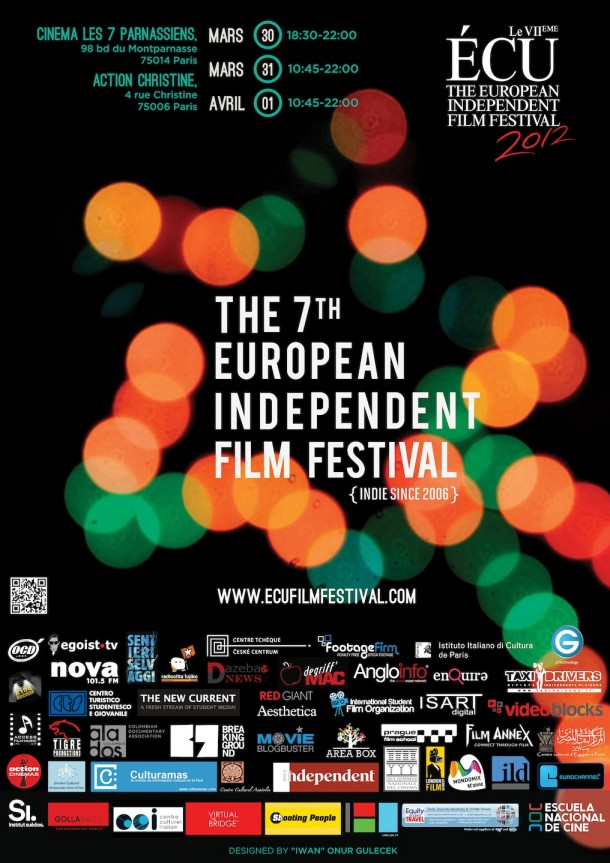
As we look back on 20 years of the European Independent Film Festival, we decided to get in touch with some of of the directors from ÉCU’s past Official Selections over the years. In this trip down memory lane, we interviewed some of these filmmakers on their past work and current projects while spotlighting the films they brought to the festival
In this edition of the alumni series, we heard from three documentary filmmakers who showcased their work in 2012. We talked about their professional and creative trajectories as well as their experience participating in the festival. Our guests include Franck Onouviet (The Rhythm of My Life – ISMAEL SANKARA), Phoebe Hart (Orchids: My Intersex Adventure), and Emily McMehen (Achanté).
Franck Onouviet
“I use the camera as a brush to paint a canvas”
Navigating international boundaries across Gabon, France, and New York (where he trained at the New York Film Academy) Franck Onouviet’s roots in documentary film have only expanded through his heralding of new genres of cinema. Targeted towards “crafting local stories for a global impact” through his current role as founder of the production house Owanga Studios, Onouviet’s trajectory has straddled documentary and fiction. The Rhythm of My Life – ISMAEL SANKARA, co-directed by Onouviet and his cousin Marc Tchicot competed for Best (non-European) documentary at the 2012 ÉCU Film Festival, where it won the Audience Award.
Onouviet’s documentary offers a look into the remarkable story of Miami-based rapper Ismael Sankara, who joins the local rap scene in Libreville, Gabon. The documentary takes its audience behind the scenes of the creative processes of musical production. For Onouviet, participating–and eventually winning–at ÉCU was an affirmation of the universal resonance of his story. He recalls, “the Audience Award for us was the best award we could win…we did something in Gabon, in a different culture, in a different country and realised that people from different backgrounds just took that story, grasped it, and enjoyed it.” For his team, it was a “testimony” to the global reach of their storytelling.
In The Rhythm of My Life, there is a moment where one of Sankara’s producers expresses his regret in not recording the rapper creating a freestyle rap. Extending this desire to capture instances of spontaneity to Onouviet’s work, I asked the director about his own creative method and how much of his process is driven by the need to record such “freestyle moments”. Onouviet expressed the frustration inherent in documentary film-making of being unable to record his subjects 24/7, always fearing he would miss out on important moments of storytelling.
To mitigate some of these frustrations, Onouviet explains how on a recent project documenting arts education for visually impaired people, he found himself constantly moving between two groups of subjects, balancing out the challenge of having a single camera by keeping his ear glued to one room while filming in the other. Today, he is compelled by capturing testimonies of cultural practices, explaining, “there are a lot of cultures that [have been] disappearing overnight and we don’t know that [this] has been happening for years and years and years.”
You can watch The Rhythm of My Life here.
Phoebe Hart
“One of the new challenges of working in documentaries is that you can express a different kind of truth”.
Traversing theory and practice, Phoebe Hart is a documentary filmmaker and presently an associate Professor at the School of Creative Arts at the Queensland University of Technology in Brisbane. Hart’s career began in local broadcasting in Brisbane before she decided to pursue other goals, freelancing and studying towards a PhD. In 2012, her widely-celebrated autobiographical feature Orchids: My Intersex Adventure, which was the culmination of her doctoral studies, competed in the Best (non-European) Documentary category at ÉCU. And she joins us now.
“I felt like the stories that people had to tell were really important”, Hart says in response to why she chose to make documentary films, referencing the old adage of life often being stranger than fiction. Orchids is a deeply personal story for Hart–an exploration of her intersex condition, kept hidden from her for a large part of her childhood. After she finally discovered the truth of her condition, she soon came to be made aware of others who had been shamed for being intersex, some of whom she interviews in her documentary.
Hart’s story, however, resonated more widely. As she explains, although the film “was meant to empower people within the community” it eventually “translated to anyone who had experienced some kind of otherness as a child or as a young adult.” Through interviews with her sister Bonnie on the dehumanising experience of medical documentation to the wider deluge of unattainable body types inundating popular culture, Hart explores the ambiguities embodied by intersex people as seeming to encroach on societal borders on what constitutes the “normal”.
The film incorporates different types of visual media, including animation and family footage and Hart embraces the interplay of media in her work, affirming, “I’ve always been someone who’s been able to work in a multitude of forms and different materials”. While she frequently gets asked whether she plans to make a sequel to Orchids, addressing the evolution of how intersex people have been treated in the last few decades, Hart has been actively working on other projects. Most recently, she has published a monograph, Crafting contemporary documentaries and docuseries for global screens: docu-mania, which explores documentary practices post-Covid.
Later this year, she will begin filming a new documentary on indigenous art in Australia and Taiwan.
Emily McMehen
“Every film is completely different because each one is a collaboration.”
Presently at the helm of the production house Mazibel, Emily McMehen’s documentaries and shorts have received widespread acclaim, screening at Cannes and the Venice Biennale, amongst other international film festivals. While McMehen initially trained as a sculptor, her engagement with mixed-media has pervaded her work in documentary film and abstract cinema. Her academic research has centred on the philosophy of the moving image. In 2012, she competed at ÉCU with her short Achanté, winning Best Independent Experimental Film.
When McMehen and her team arrived in Haiti in early 2010 to shoot their immersive portrait of Vodou practices in the Caribbean country, they could not have predicted the magnitude 7.0 earthquake set to devastate the island. McMehen recounts, “what started out as a research and development trip suddenly became a humanitarian effort”. Deciding to forgo filming in order to help with the humanitarian effort, the team were driven by a refusal to add to the deluge of “strangers with cameras” on the island, inundating the country in the aftermath of the earthquake.
When I asked McMehen whether this response reflected a kind of cynicism towards visual storytelling, she explained that the cynicism of the Haitians towards being filmed during the crisis came rather from “having a stranger come and take [their] narrative away from [them].” Historically, she explains, exchanges between Haitian and European artists have been asymmetrical. She notes, while 20th-century Surrealists, for instance, travelled to Haiti and returned to exhibit works heavily inspired by Haitian art (notably in the seminal Le Surréalisme en 1947 exhibition in Paris organised by André Breton, Marcel Duchamp, and Aimé Maeght), Haitian artists were rarely asked to come discuss their work in such public settings.
The spirit of inclusion certainly inspired McMehen’s own process when filming in Haiti. “We wanted to share creative control with the people that we were working with”, she says. These shared creative stakes with the crew eventually posed a challenge to editing the movie. Navigating the large amounts of footage that had garnered from months of shooting was also dictated by the particularities of Vodou spirits, that correspond only to certain colours and music.
For McMehen, it is a great moment for cinema, especially independent film. She extols the growing access to more high-quality equipment as well as the dissemination of knowledge over the internet, through YouTube Tutorials, for instance. Excited by indigenous voices in film that offer non-traditional narratives, McMehen’ cites Carlos Reygadas’ 2012 Post Tenebras Lux, Apichatpong Weerasethakul’s 2012 Mekong Hotel, and Eduard Novikov’s Yakut led 2018 The Lord Eagle as inspirations for her own work.
McMehen is currently working on her first feature film, set in Mongolia, in collaboration with Mazibel co-founder Geofrrey Sautner. To learn more about McMehen’s past projects and works in development, check out her website.
 English
Leave a Reply